

.jpg?width=60&name=ECP-Headshot%20(1).jpg)
For many years, graphics pipelines relied on established, fixed function workloads such as geometry processing, rasterisation, texturing and shading. This traditional approach provided a predictable structure to rendering, with each stage offering a specific, well‑understood function.
However, this model has undergone a quiet but profound shift. Modern rendering is now characterised by compute-driven processes, neural inference and an increasing reliance on AI-assisted image formation. The role of AI in graphics has evolved beyond that of a supplementary feature; it is becoming integral to the way images are rendered, enhanced, reconstructed, and synthesised.
Consequently, the future direction for GPUs is evident: they must incorporate efficient AI acceleration across desktops, cloud platforms, and edge devices. Today’s chips are responsible for handling workloads ranging from geometry processing to image enhancement and reconstruction. This shift positions AI acceleration at the core of modern rendering, underpinning the advancement and quality of graphics in contemporary systems.
Across the industry, modern engines have shifted away from fragment heavy pipelines and towards compute dominant ones. This can be seen particularly in high-end PC engines and console class workloads. A comparison between earlier engines and contemporary pipelines illustrates this transition clearly: where traditional pipelines were dominated by fragment shading, modern engines allocate a substantial and growing proportion of frame time to compute workloads. Lighting, material evaluation, visibility processing, and post‑processing have increasingly migrated into compute‑driven stages.
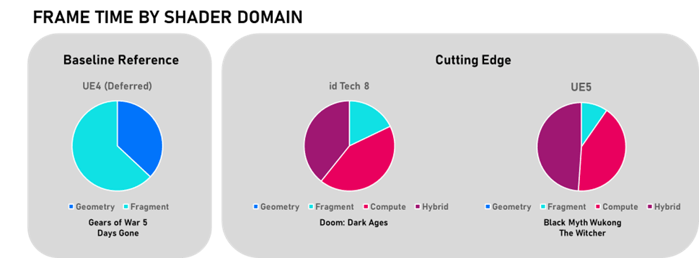
Contemporary rendering pipelines increasingly rely on compute shaders to drive lighting, materials, visibility, and postprocessing. The proportion of traditional fragment shading is steadily falling; compute shaders and upscaling, denoising and enhancement techniques already consume a significant portion of GPU frame time. Technologies like DLSS and FSR, once considered premium features, are now standard expectations in modern engines. They use neural networks to reconstruct high‑resolution frames from lower‑resolution inputs, apply high‑quality denoising, and maintain temporal stability under tight latency constraints.
Our internal analyses reflect this shift clearly. In modern rendering pipelines, an increasing fraction of frame latency is no longer spent directly “drawing” pixels, but instead of inferring a perceptually complete image from a sparse base (lower resolution inputs, fewer shading samples, and aggressive temporal reuse) using neural methods.
This is a pattern which commercial hardware decisions mirror. For example, Sony’s transition from PlayStation 5 to PlayStation 5 Pro involved an approximate 4× increase in silicon within the GPU subsystem overwhelmingly dedicated to neural compute, not traditional shading or fixed function raytracing. This reflects a clear industry judgement: future gains in image quality are expected to come primarily from reconstruction and inference, not from brute‑force fragment throughput.
From an architectural perspective, real‑time 3D graphics has always been defined by approximation rather than mathematical completeness. The primary constraint has never been correctness, but bounded latency and energy, which forces engines to aggressively eliminate work that does not materially improve perceived image quality. Techniques such as visibility culling, level‑of‑detail, temporal reuse and reconstruction are all manifestations of the same principle: remove unnecessary computation to reallocate silicon and power budget to the elements that truly differentiate.
This philosophy has direct consequences for GPU design. As workloads become increasingly dominated by reconstruction, inference and approximation, the architectural priority shifts away from maximising raw fragment throughput and towards enabling dense, efficient execution of small‑to‑medium sized neural workloads directly within the rendering pipeline. Neural shaders represent a natural evolution of this trajectory: embedding compact networks into shading stages allows approximation to be learned expressly, in a data‑driven form, and tightly coupled to existing shader execution and memory access patterns.
Supporting this efficiently requires GPUs to treat neural execution not as an auxiliary compute task, but as a first‑class architectural concern optimised for low latency, high utilisation, and fine‑grained integration with traditional shading rather than isolated, batch‑oriented inference.
While neural upscaling is already mainstream, neural shaders (small networks embedded directly within the shading pipeline) are emerging as the next major shift in real‑time graphics. Industry hype‑cycle analyses suggest that neural shading has progressed from early innovation stages toward broader adoption later in the decade. We have already presented research on neural approximation techniques, and the expectation is that GPUs will need to support efficient neural execution as part of ordinary shading workloads, not a separate compute path.
This is backed by the direction of R&D. The fastest way to predict where graphics workloads are going is to track SIGGRAPH. Over the last two years, the volume of neural-driven graphics research has surged dramatically. Examples include:
- Neural materials and neural implicit surfaces, delivering real‑time, learnable representations for complex assets
- Diffusion‑based asset extraction and content synthesis, using generative models to produce and refine 3D content
- Neural denoising, reconstruction, and hybrid generative workflows, visible across recent SIGGRAPH publications
- Neural‑driven artistic and design tools, embedding AI directly into content creation pipelines
Hardware teams planning multiyear architectures must recognise this timeline, because GPU blocks designed today must support the workloads of 2028 and beyond. The sheer volume and breadth of neural graphics research, spanning materials, animation, rendering, and tools, provides unmistakable evidence that AI has become a foundational discipline within computer graphics. Taken together, the industry signals are consistent: rendering is no longer about maximising FP32 fragment throughput, but about flexible, general‑purpose compute.
And when future graphics workloads rely heavily on neural processing, then GPU architects cannot depend on scalar or traditional shader cores to run them efficiently. Neural workloads require higher compute density, lower energy per inference and support for small‑to‑medium sized networks tightly integrated into shaders with complementary memory access patterns.
This is why Imagination is integrating AI acceleration directly into our GPU architectures, so that our customers can support the forefront of computer graphics. Our E‑Series GPU IP supports both graphics and general inference use cases, delivering high throughput at low power thanks to the tight integration of our AI acceleration and our traditional shading clusters.
In a future where real‑time graphics is defined by reconstruction, approximation, and neural execution, treating AI as a first‑class part of the rendering pipeline is not optional—it is essential.
If you want to find out more about our ambitious roadmap for edge graphics and AI, reach out to book a meeting with our teams.


.png)
